Agent Reliability

Agent Evaluation Flywheel: From Prototype to Reliable Production

A practical evaluation loop for tool-using AI agents, covering task datasets, trace-level scoring, release decisions, production feedback, and failure ownership.
April 10, 20264 min readAgent EvaluationAI Agents
An agent can produce an impressive demo and still be unsafe to release. The difficult failures are rarely limited to a bad final sentence. The agent may choose the wrong tool, pass malformed arguments, repeat an action, ignore weak evidence, or complete the task while violating a business rule. That is why I evaluate agents as workflows, not as isolated model responses. The goal of an evaluation flywheel is not to create a single score. It is to turn real failures into reproducible tests, make release decisions explicit, and shorten the path from incident to verified correction.

Start with the task contract

Before choosing metrics, define what successful execution means for each task family. A useful task contract describes:
  • the user intent and relevant context;
  • the allowed tools and side effects;
  • the expected intermediate decisions;
  • the evidence required before answering;
  • the acceptable fallback or escalation path;
  • the conditions that must never occur.
For a read-only knowledge agent, success may require the correct source, a grounded answer, and an explicit refusal when evidence is insufficient. For an action-oriented workflow, the contract also needs to cover authorization, argument validation, idempotency, and confirmation before an irreversible operation. The dataset should represent those contracts. I prefer a compact set of high-value tasks over a large collection of easy prompts. It should include normal journeys, ambiguous requests, missing data, tool failures, permission boundaries, adversarial instructions, and previously observed regressions.

Score the trace, not only the answer

A final-answer score hides where the workflow failed. Trace-level evaluation separates the system into observable decisions:
LayerQuestions to evaluate
RoutingDid the agent select the correct workflow and risk policy?
RetrievalDid it query the right source and preserve relevant evidence?
Tool useWere the tool, arguments, sequence, and retry behavior valid?
SynthesisIs the answer supported, complete, and appropriately uncertain?
PolicyWere authorization, privacy, and escalation rules respected?
OperationsWere latency, cost, and failure signals captured for diagnosis?
Some checks should be deterministic. Schema validity, forbidden tool calls, citation existence, and required confirmations do not need a model judge. More subjective dimensions, such as completeness or helpfulness, can use rubric-based evaluators, but they still need calibrated examples and periodic human review.

Turn evaluation into a release decision

An evaluation run is useful only if it changes what the team does. I use three kinds of decision rules:
  • Hard blockers for security, privacy, authorization, or destructive-action failures.
  • Segmented quality checks for critical intents, languages, sources, and user groups.
  • Trend checks to catch a regression that a global average would hide.
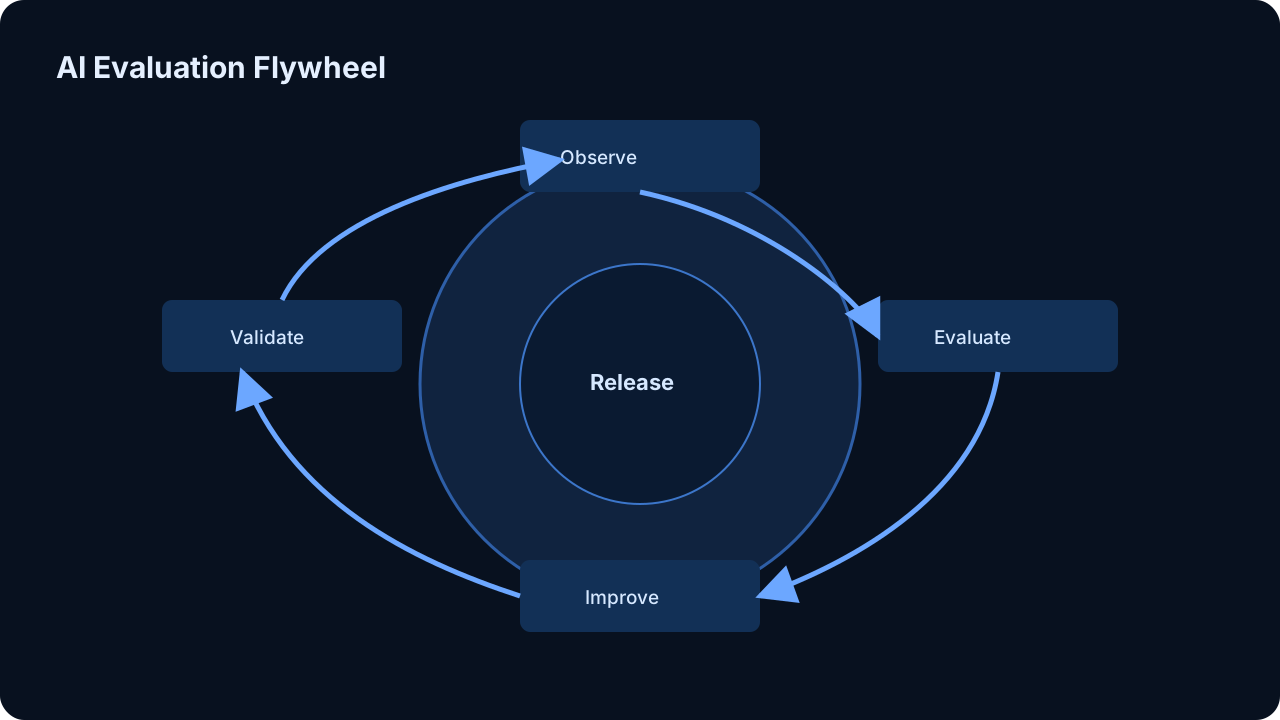
The thresholds should come from product risk and an established baseline, not from a universal number copied from another system. A low-risk internal assistant and an agent that can modify financial records should not share the same release policy. Every failed gate should point to an owner and an inspectable trace. Otherwise, the team receives a red dashboard without knowing whether to change the prompt, retrieval layer, tool contract, model, or application code. The regression alerting blueprint shows how these gates become comparable alerts tied to release and rollback decisions.
Evaluation flywheel connecting release, observation, evaluation, improvement, and validation
The useful loop is operational: production signals become reproducible cases, then verified changes.

Close the loop with production feedback

Offline tests protect known behavior, but production traffic reveals new language, intents, source gaps, and integration failures. The feedback loop should collect:
  • explicit user feedback with the associated trace;
  • fallbacks and human escalations;
  • tool errors, timeouts, and repeated calls;
  • low-confidence retrieval and missing citations;
  • corrected answers from subject-matter experts;
  • incidents grouped by task family and root cause.
Not every production conversation belongs in the evaluation set. Sensitive data must be removed or protected, duplicate cases should be consolidated, and examples need clear expected behavior. The result is a curated regression corpus, not a raw log archive. This operating discipline is visible in my public DAISI case study, where evaluation traces, integration tests, security controls, and load testing are presented as separate production-readiness concerns. The case study is evidence of the delivery approach; the exact evaluation policy remains specific to each product and risk level.

Diagnose failures before changing the model

When an evaluation fails, changing the model first is often the most expensive response. I classify the failure before choosing a fix:
  • contract failure: the expected behavior was never defined clearly;
  • context failure: required information was missing or stale;
  • retrieval failure: the right evidence was not found or ranked;
  • orchestration failure: the workflow chose a wrong branch or tool sequence;
  • tool failure: an integration returned an error or ambiguous result;
  • generation failure: the model misinterpreted good evidence;
  • policy failure: a guardrail or confirmation boundary was bypassed;
  • evaluation failure: the test or judge itself is unreliable.
This taxonomy avoids prompt-only fixes for data or software defects. It also makes ownership clearer across product, platform, data, security, and domain teams.

A pragmatic rollout

Start with a small dataset of business-critical tasks and deterministic checks around tool contracts and safety. Add trace-level rubrics for the decisions that genuinely require judgment. Run the suite on every meaningful workflow change, store the results with the code and configuration version, and review failures before release. Once that loop is stable, add production sampling, expert corrections, and segmented dashboards. The flywheel becomes valuable when every serious failure can answer three questions: Can we reproduce it? Do we know who owns it? Can we prove the fix did not break something else?

Sources and references

  1. LangSmith evaluation documentationExperiment tracking, datasets, evaluators, and trace analysis
  2. RAGAS documentationEvaluation concepts for retrieval and grounded generation
  3. OpenAI EvalsPatterns for reproducible model and workflow evaluation

From principles to shipped systems

These articles document the methods behind my work. The project case studies show how I apply them across enterprise agents, RAG, and MLOps.

Continue exploring

Related field notes on the architecture, evaluation, and operating decisions behind production AI systems.
April 11, 20264 min readSynthetic DataFine-Tuning

Synthetic Data Pipeline for Domain Fine-Tuning

A controlled pipeline for generating, filtering, versioning, and evaluating synthetic domain data without hiding contamination, policy, or distribution risks.