Machine Learning Systems

Synthetic Data Pipeline for Domain Fine-Tuning

A controlled pipeline for generating, filtering, versioning, and evaluating synthetic domain data without hiding contamination, policy, or distribution risks.
April 11, 20264 min readSynthetic DataFine-Tuning
Synthetic data is useful when real domain examples are scarce, sensitive, expensive to label, or incomplete around important edge cases. It is dangerous when a team generates a large volume of plausible text and assumes quantity will improve the model. A production pipeline must make three things visible: why each example exists, how it was generated, and whether it improves behavior on independent real tasks.

Define the coverage gap first

Do not start by asking a model to create “more examples.” Start with a coverage map:
  • target tasks and output formats;
  • languages, domains, and user profiles;
  • common and rare intents;
  • safety and refusal boundaries;
  • tool or structured-output requirements;
  • known error clusters;
  • examples explicitly excluded from training.
Each generation job should target one documented gap. This makes the dataset inspectable and prevents a high-volume category from overwhelming rarer but critical behavior. Real examples, domain documentation, schemas, and expert-authored templates can provide seeds. They should be versioned and separated by data rights and sensitivity. Sensitive source material must not be sent to an unapproved generator or reproduced in synthetic outputs.

Generate with provenance

For every synthetic record, store:
  • generation job and objective;
  • seed or template identifier;
  • generator model and configuration;
  • prompt version;
  • decoding parameters;
  • generation timestamp;
  • raw output and transformations;
  • validation results;
  • review status and final disposition.
Use structured generation when the target has a schema. Generate inputs and expected outputs separately when possible, then verify their consistency. For classification or extraction, programmatic templates can provide stronger control than unconstrained generation. Diversity should be intentional. Vary the linguistic surface, context length, ambiguity, and difficulty without changing the target semantics. A generator that repeatedly paraphrases the same easy case creates apparent volume without new information.

Filter in layers

No single quality score is sufficient. I use layered filters:
  • Schema checks: required fields, types, ranges, and parseability.
  • Policy checks: sensitive content, prohibited topics, unsafe instructions, and data leakage.
  • Deduplication: exact, normalized, and semantic similarity against train and evaluation sets.
  • Consistency checks: answer supported by the provided context, valid tool arguments, labels aligned with rules.
  • Difficulty and coverage checks: distribution matches the generation objective.
  • Expert sampling: domain review for categories where automatic checks are weak.
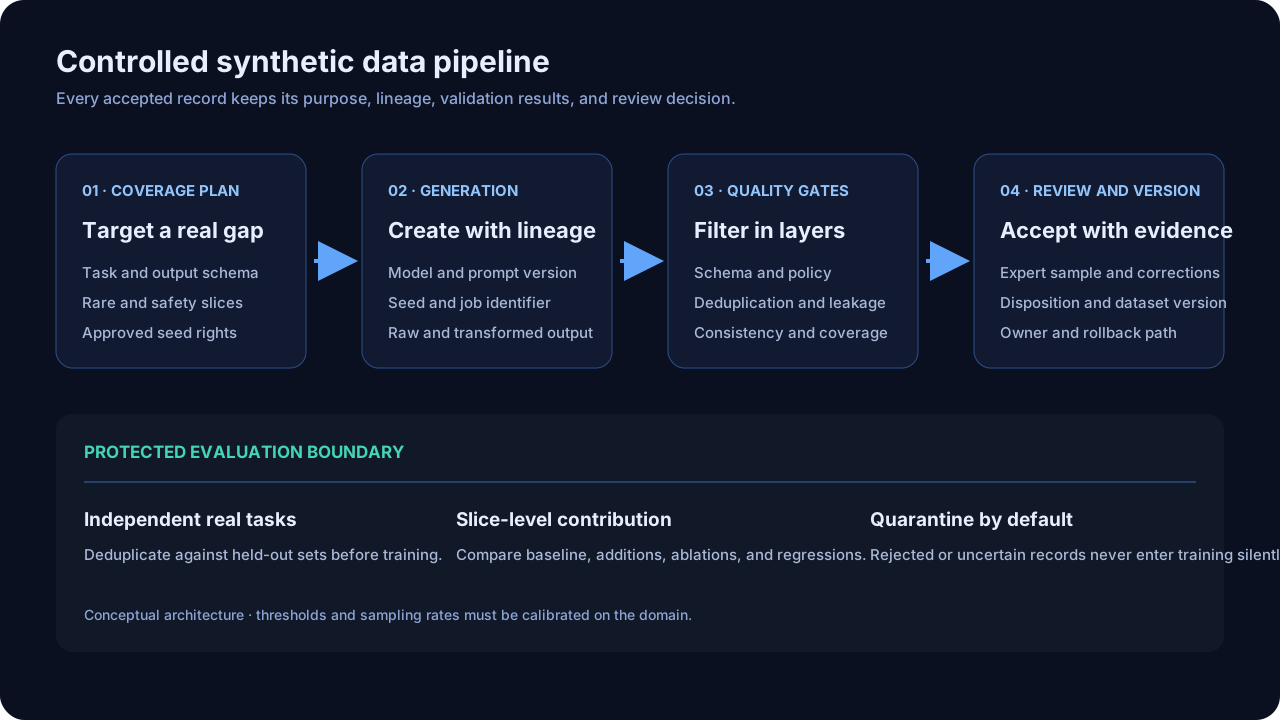
Model-based judges can help triage, but they should not be the only filter when the same model family generated the data. Agreement between models is not proof of domain correctness.
Synthetic data pipeline connecting coverage planning, generation provenance, quality gates, expert review, versioning, and protected evaluation
A trustworthy synthetic dataset keeps provenance, filtering decisions, expert review, and evaluation coverage inspectable for every generation campaign.

Protect the evaluation boundary

Synthetic data can contaminate evaluation silently. If the generator sees held-out examples, evaluation prompts, or close paraphrases, the final score may measure memorization of the benchmark design. Maintain immutable evaluation sets with restricted access. Deduplicate generated records against all evaluation splits before training. When synthetic examples are derived from a real case, group related variants so they cannot land on both sides of the train-test boundary. The final evaluation should prioritize independent, real domain tasks. Synthetic holdouts can test specific rules, but they cannot prove that the model generalizes to real users.

Version data and training together

A fine-tuning result is reproducible only if the team can connect it to the exact:
  • source and synthetic dataset versions;
  • filtering configuration;
  • sampling weights;
  • tokenizer and base model;
  • training code and hyperparameters;
  • evaluation suite and evaluator versions.
Track quality by dataset slice, not only by training loss. If performance improves on the dominant synthetic category while regressing on real edge cases, the pipeline has optimized the wrong distribution. The production MLOps checklist expands on the lineage, release evidence, monitoring, and rollback controls required around the resulting model. My public Ecotopia case study describes fine-tuning four Mistral models with QLoRA and building structured evaluations during a 48-hour hackathon prototype. It does not claim the use of this synthetic-data pipeline. The relevant connection is the discipline of comparing specialized model behavior with explicit evaluation rather than treating fine-tuning loss as the product metric.

Evaluate contribution, not just the final model

Run controlled comparisons:
  • baseline without synthetic data;
  • real data plus one synthetic slice;
  • cumulative slices in a documented order;
  • alternative sampling weights;
  • ablations of filters or generation strategies.
Measure task quality, safety behavior, calibration, structured-output validity, and regressions by slice. Review examples that changed the prediction in either direction. This reveals which synthetic categories add signal and which create shortcuts. The result may show that a smaller curated dataset is better than a larger generated one. Removing low-value synthetic records is a successful pipeline outcome.

Roll out with monitoring and reversion

Start with one measurable coverage gap and a small reviewed batch. Train a candidate, evaluate it against the real baseline, and inspect failures before scaling generation. Version the accepted data and preserve a path back to the previous model and dataset. In production, monitor the task segments targeted by synthetic data, as well as unrelated segments that could regress. Collect corrected real examples carefully and decide whether they belong in evaluation, training, or both under a controlled grouping policy. Synthetic data becomes valuable when it is treated as versioned software input with lineage and tests, not as inexpensive text.

Sources and references

  1. NVIDIA NeMo Curator documentationData-curation components and scalable processing concepts
  2. Hugging Face Datasets documentationDataset construction, transformation, versioning, and distribution
  3. Weights & Biases Reports documentationExperiment comparison and evaluation reporting

From principles to shipped systems

These articles document the methods behind my work. The project case studies show how I apply them across enterprise agents, RAG, and MLOps.

Continue exploring

Related field notes on the architecture, evaluation, and operating decisions behind production AI systems.