Agent Reliability

Evaluation Regression Alerting Blueprint for AI Products

A blueprint for detecting meaningful AI quality regressions with stable baselines, segmented signals, release checks, and alerts that lead to an actionable diagnosis.
April 13, 20264 min readAI EvaluationRegression Testing
An evaluation dashboard can show a lower score without telling the team whether a release is actually worse. The change may come from a harder dataset, a noisy model judge, a new traffic mix, or one critical intent collapsing while the global average remains stable. Regression alerting must therefore compare like with like, preserve enough context to explain the movement, and connect every alert to a release or operational decision. This article focuses on that detection layer. The broader process for turning failures into evaluation cases is covered in the agent evaluation flywheel.

Define the unit of comparison

The first design choice is what constitutes a comparable evaluation run. At minimum, retain:
  • dataset and example versions;
  • prompt, model, retrieval, and tool configuration versions;
  • evaluator and rubric versions;
  • sampling rules and random seeds when applicable;
  • environment and dependency versions;
  • the segment attached to every example.
Without this lineage, a score movement is ambiguous. A new model evaluated on a different dataset is not a regression test. It is a new experiment. I keep a stable reference suite for release comparison and a separate discovery suite for newly collected cases. The reference suite changes deliberately and keeps historical results interpretable. The discovery suite can evolve faster before high-value examples are promoted into the reference baseline.

Segment before aggregating

Global averages are useful for orientation but weak for release safety. An internal assistant may improve overall while failing on one document family, language, integration, or high-risk workflow. A useful segmentation model can include:
DimensionExample segments
IntentLookup, comparison, explanation, action request
RiskInformational, sensitive, approval required
EvidenceStrong source, conflicting sources, insufficient source
IntegrationRetrieval only, one tool, multi-tool workflow
User contextLanguage, business unit, permission level
Failure historyStable flow, recent incident, known weak area
Alerts should identify the affected segment and provide links to failing examples and traces. A global alert without a failure cluster is difficult to act on.

Use different detectors for different signals

Not every metric should use the same alert rule. Deterministic failures such as invalid tool arguments or missing required citations can block a release as soon as they appear in a critical case. Continuous metrics such as groundedness or task completion need a baseline, a minimum sample size, and a tolerance that reflects evaluator noise. For production signals, compare distributions and rates over an appropriate window rather than reacting to one request. Consider traffic volume, seasonality, and changes in user mix. A sudden rise in fallback usage may indicate a source outage, but it may also reflect a new category of questions. The alert should trigger investigation, not automatically prescribe the cause. The important distinction is:
  • release regression: a candidate version performs worse than its reference on comparable cases;
  • production drift: live behavior or input distribution moves away from the validated operating range;
  • evaluation drift: the dataset, rubric, or judge changes enough to invalidate the comparison.

Design alerts that carry a diagnosis

An actionable regression alert should include:
  • the candidate and reference versions;
  • the affected metric and segments;
  • the absolute and relative change;
  • the number of evaluated examples;
  • representative failed cases and trace links;
  • the last known good version;
  • the owner and expected decision.
Avoid alerting on every metric movement. Route security or authorization failures immediately, send release regressions to the owning engineering team, and review slower business-quality trends on a planned cadence. This prevents an alerting system from becoming background noise.
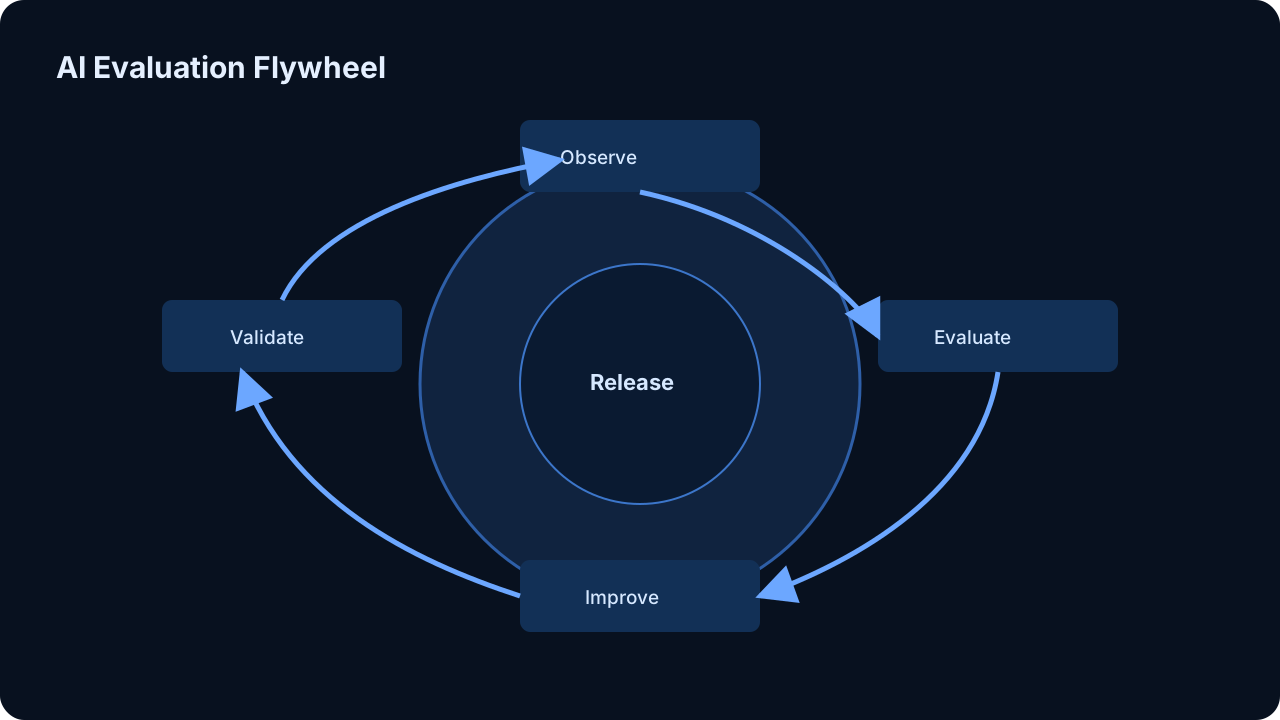
Evaluation loop in which observed regressions become validated test cases
Regression alerts are one part of the loop: they must preserve lineage, identify a failure cluster, and lead to a verified correction.

Connect alerts to release and rollback policy

The response to a regression depends on its severity and reversibility. A candidate can be blocked when a critical policy case fails, while a lower-risk quality movement may require review and a staged rollout. Production alerts may pause traffic expansion, route users to a safe fallback, or return to the last validated configuration. The policy should be explicit before an incident:
  • which failures block deployment;
  • who can approve an exception;
  • which configuration can be rolled back independently;
  • how the safe fallback is verified;
  • what evidence is required to close the incident.
This discipline also applies to governed RAG systems. My public OpsBot case study describes evaluation traces, source-backed answers, and safe fallback as separate runtime controls. It does not publish internal evaluation results, but it illustrates why alerting must connect retrieval quality, application behavior, and operational response.

Roll out without creating alert fatigue

Start in shadow mode. Compute regression signals and review them without blocking releases. This reveals noisy evaluators, unstable segments, and thresholds that would create false alarms. Then promote only well-understood, high-value checks into release gates. Add production alerts gradually, beginning with deterministic safety failures and integration health. Review alert usefulness after incidents: did the alert arrive early enough, identify the right owner, expose relevant traces, and lead to the correct action? Remove or redesign alerts that do not. The strongest regression system is not the one with the most metrics. It is the one that can state, with evidence, what changed, where it changed, whether the change matters, and what decision the team should make next.

Sources and references

  1. RAGAS documentationEvaluation metrics and experiment concepts for retrieval-based systems
  2. LangSmith evaluation documentationDatasets, experiments, evaluators, and trace analysis

From principles to shipped systems

These articles document the methods behind my work. The project case studies show how I apply them across enterprise agents, RAG, and MLOps.

Continue exploring

Related field notes on the architecture, evaluation, and operating decisions behind production AI systems.