Production AI Operations

vLLM Serving Blueprint: Low-Latency Inference at Scale

A sourced vLLM serving blueprint covering workload design, continuous batching, KV-cache pressure, admission control, observability, capacity tests, and safe rollout.
April 10, 20265 min readInference EngineeringvLLM
vLLM can improve accelerator utilization through continuous batching and efficient KV-cache management, but an inference engine is only one layer of a reliable serving platform. Queueing, admission control, model lifecycle, observability, and client behavior often determine whether the system meets its real objective. This is a sourced architecture blueprint, not a claim that I have shipped vLLM in production. The aim is to show how I would reason about the serving problem and which evidence I would require before calling the platform ready.

Define the workload before the architecture

“Low latency” is incomplete without a workload definition. Capture:
  • model family, precision, and memory footprint;
  • input and output token distributions;
  • streaming versus non-streaming clients;
  • request concurrency and burst shape;
  • number of models and adapters;
  • context-length policy;
  • availability and data-boundary requirements;
  • latency objective for first token and full completion;
  • throughput and cost objectives.
Time to first token and inter-token latency affect user experience differently. A long analytical request and an interactive assistant should not share one undifferentiated service-level objective. Create a representative load model from expected product traffic. Uniform synthetic requests hide the effects of long contexts, output variance, cache pressure, and bursty arrival patterns.

Understand the engine's resource tradeoffs

Continuous batching allows the engine to add and remove requests as generation progresses. This can improve throughput compared with fixed batches, but it also creates scheduling choices between short interactive requests and long generations. KV cache is another central constraint. Longer contexts, more concurrent sequences, and larger models consume memory quickly. Prefix caching can avoid repeated work when requests share stable prefixes, but the benefit depends on real cache reuse and a key boundary that respects model, tokenizer, adapter, and policy versions. Tune with measured traffic rather than copying a configuration. Important variables include maximum sequence counts, token budgets, memory utilization, tensor or pipeline parallelism, quantization, and chunked prefill behavior. Each change can move throughput, latency, memory pressure, and output quality in different directions.
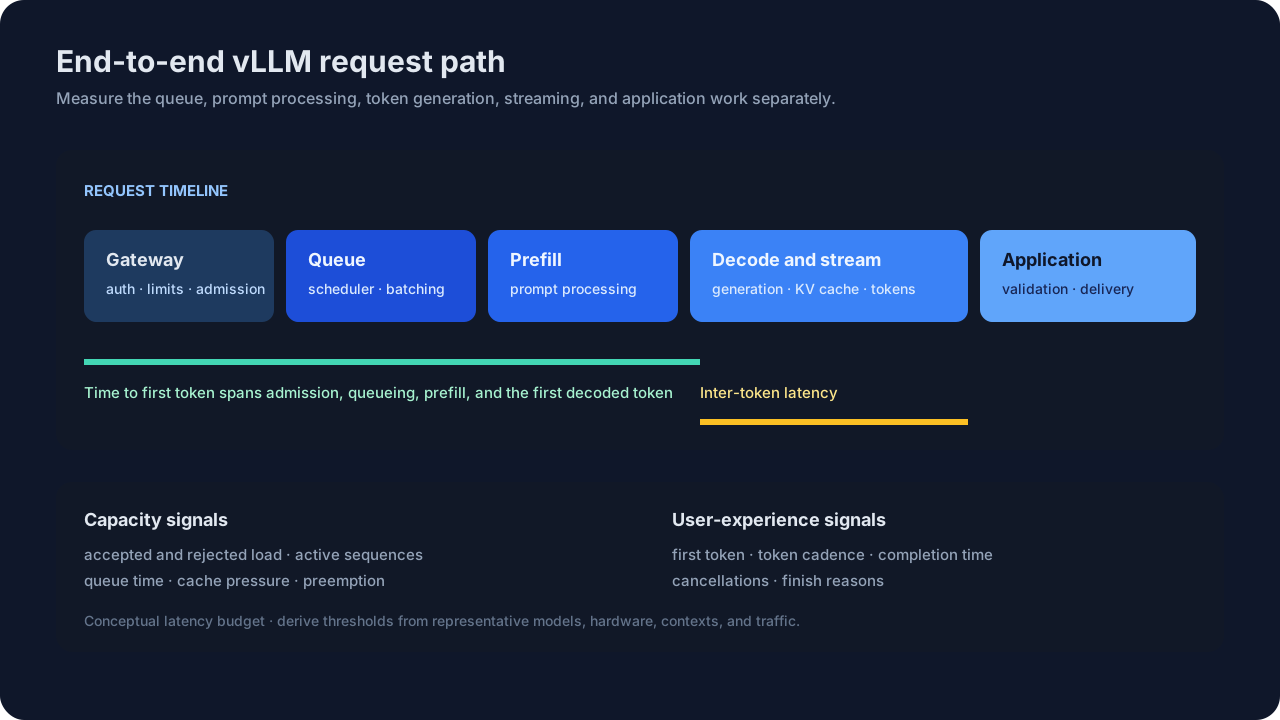
Inference request latency broken down across queueing, prompt processing, generation, and post-processing
The useful latency budget follows the full request path. Engine tuning cannot compensate for an unbounded queue or an overloaded gateway.

Put admission control before the engine

An overloaded server should not accept unlimited work and hope batching will recover. The gateway needs:
  • authentication and tenant quotas;
  • request and context-size limits;
  • bounded queues;
  • deadlines and cancellation propagation;
  • concurrency controls by workload class;
  • backpressure and explicit overload responses;
  • safe routing to healthy replicas or fallback capacity.
Separate workload classes when they have incompatible behavior. Interactive chat, offline batch generation, and very long contexts can compete unfairly for the same cache and scheduler. Isolation can be physical or policy-based, but it must be measurable. Retries require care. A client that retries a timed-out generation while the original request continues can double the load during an incident. Propagate cancellation and use retry budgets with jitter and a clear set of retryable failures.

Design the serving and deployment layers

A practical platform separates:
  • gateway: identity, quotas, validation, routing, and request metadata;
  • serving pool: vLLM replicas with explicit model and hardware configuration;
  • model lifecycle: artifact validation, warm-up, readiness, and version promotion;
  • telemetry: traces, engine metrics, logs, and cost attribution;
  • control plane: autoscaling, rollout, rollback, and capacity policy.
Readiness must mean more than an open port. A replica should load the expected model and tokenizer, pass a representative inference check, expose telemetry, and remain out of rotation during warm-up. Keep model promotion independent from application deployment where possible. A versioned route or weighted policy makes canary validation and rollback clearer than replacing every replica at once.

Observe the queue, cache, and user experience

GPU utilization alone cannot explain serving quality. Track:
  • request rate, accepted load, and rejected load;
  • queue time and active sequences;
  • time to first token and inter-token latency distributions;
  • prompt and generated tokens;
  • KV-cache usage and preemption;
  • prefix-cache behavior where enabled;
  • cancellations, timeouts, and finish reasons;
  • errors by model, replica, tenant, and workload class;
  • cost or accelerator time per successful request.
Trace the gateway, queue, engine, and streaming path with shared request identifiers. Avoid storing sensitive prompt content in unrestricted telemetry. Metadata and sampled, access-controlled traces are usually safer. The LLM observability guide explains how to connect those traces to quality, cost, alerts, and incident response. The latency values in a dashboard must come from the measured workload. There is no universal vLLM target that applies across models, hardware, contexts, and products.

Test failure and capacity boundaries

A load test should vary context length, output length, concurrency, and burst patterns. Continue until the platform crosses a boundary, then document how queue time, rejection, latency, and recovery behave. A test that never reaches saturation cannot validate overload policy. Also test model-load failure, unhealthy replicas, lost clients, rolling updates, exhausted cache, slow downstream streaming, and sudden traffic shifts between workload classes. The serving discipline is related to the public AI Product Photo Detector case study, which covers FastAPI serving, model registry, infrastructure, monitoring, and CI/CD for a different ML workload. That project is not evidence of vLLM use. It demonstrates the same principle that a model endpoint needs lifecycle, observability, testing, and rollback around it.

Roll out with reversible evidence

Begin with a single model and representative benchmark. Establish correctness and output-quality parity before optimizing performance. Add a canary replica, validate warm-up and telemetry, then send a controlled traffic share while comparing user-facing latency, errors, and output behavior with the current service. Scale only after queue and overload behavior are understood. Keep the prior route available until the new configuration has passed both load tests and real-traffic observation. A strong vLLM deployment is not defined by peak tokens per second. It is defined by predictable behavior when traffic, context length, and failures stop matching the happy path.

Sources and references

  1. vLLM documentationServing engine, parallelism, caching, and deployment configuration
  2. NVIDIA Triton Inference ServerProduction serving concepts, scheduling, metrics, and model lifecycle
  3. OpenTelemetry specificationPortable tracing and metrics semantics

From principles to shipped systems

These articles document the methods behind my work. The project case studies show how I apply them across enterprise agents, RAG, and MLOps.

Continue exploring

Related field notes on the architecture, evaluation, and operating decisions behind production AI systems.
April 12, 20264 min readLLM CostCost Optimization

LLM Cost Optimization with Quality Guardrails

A production method for reducing LLM cost through measurement, caching, routing, context control, and workload design without hiding quality regressions.
April 12, 20264 min readAI SecurityPrompt Injection

Prompt Security and Tool Hardening Checklist

A defense-in-depth checklist for prompt injection, untrusted retrieval, tool permissions, argument validation, sensitive data, confirmations, and incident response.