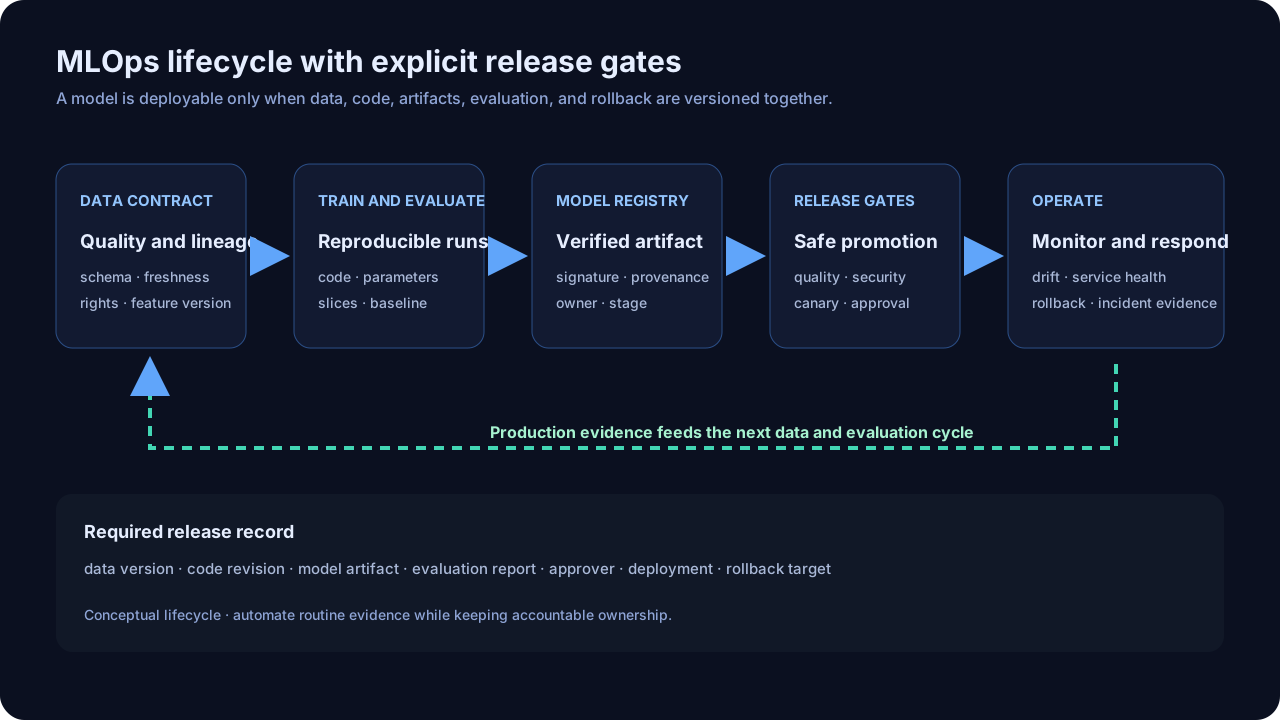
Define the production contract
Before automating a pipeline, I document what the service promises:- input and output schemas, including invalid and missing values;
- freshness and availability expectations;
- acceptable quality range for each important segment;
- runtime latency, throughput, and cost constraints;
- fallback behavior when data or inference is unavailable;
- owner for data, model, service, and business outcome.
Make training and artifacts reproducible
Reproducibility means the team can identify and retrieve the exact inputs and outputs of a run:- code and dependency version;
- dataset or snapshot identity;
- feature and preprocessing configuration;
- parameters, random seeds, and environment;
- metrics by relevant segment;
- trained artifact and signature;
- evaluation and approval result.
Build release gates around the whole system
Unit tests should cover deterministic transforms and application logic. Integration tests should verify data access, feature computation, model loading, inference contracts, and downstream consumers. Evaluation tests should compare candidate quality with a relevant baseline and protect critical segments rather than only the global average. Before release, I want evidence for:- data and schema compatibility;
- reproducible artifact lineage;
- model quality and guardrail checks;
- service performance and integration behavior;
- security and access configuration;
- staged rollout, fallback, and rollback readiness.
Minimum release evidence
Roll out safely and monitor outcomes
Deployment is not the end of validation. I prefer shadow, canary, or staged rollout for meaningful model changes. The strategy depends on whether predictions can be observed without acting, whether traffic can be split, and how quickly the effect appears. Production monitoring spans four layers:- service: latency, errors, saturation, throughput;
- data: missing values, freshness, schema, distribution movement;
- model: prediction distributions, confidence, segment performance, calibration where relevant;
- business: decision quality, adoption, cost, rework, or protected value.